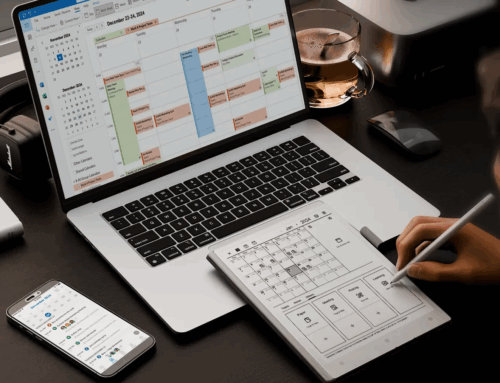


You plan your day perfectly at 9 AM. By 11:30, it’s already irrelevant.
A call runs over. An urgent issue pops up. A “quick” task takes two hours. And just like that, your carefully time-blocked schedule collapses.
If this sounds familiar, the problem isn’t your discipline. It’s how our world works.
The Promise of Time Blocking
Time blocking is a simple idea: you pre-assign your day into fixed time slots on your calendar (e.g., 9–10 AM: emails, 10–12: deep work), and then try to follow that script. It looks like the ultimate productivity solution—neat, planned, and controlled. Simple. Structured. Logical.
It’s been used for centuries—famously by Benjamin Franklin—and today it’s even easier with digital calendars. The modern poster boy of time blocking is Cal Newport, the popular author and computer science professor. I have immense respect for Dr. Newport—but he is almost an exception. He openly operates in a highly controlled environment, rarely responds to emails, and focuses on teaching and writing. Most of us don’t have that luxury—or the discipline to completely avoid the constant pull of emails and social media.
On paper, it offers everything you want: structure, focus, reduced procrastination, and the comforting feeling that nothing important will slip through the cracks.
But here’s the uncomfortable truth: Time blocking works beautifully—if you’re a hermit or a student.
Where It Breaks
Time blocking is a neat idea. No doubt about it. The problem isn’t the idea—it’s the environment it’s expected to survive in. Modern work, especially for leaders, is unpredictable by nature.
You don’t deal with repetitive, clearly defined tasks. You deal with ambiguity. Decisions. Interruptions. Shifting priorities.
You estimate a task will take 30 minutes—it takes two hours. Or the opposite. One delay throws off everything that follows. And even if your tasks behaved perfectly, the world around you doesn’t.
Priorities change mid-day. Stakeholders demand attention. New problems emerge without warning. The plan you made in the morning can become obsolete before lunch.
Then there’s the most overlooked variable of all: you.
Your energy fluctuates. Your focus rises and falls. Some hours you’re sharp; others, you’re not. Yet time blocking expects you to perform like a machine—doing deep work at 2 PM just because your calendar says so.
It’s no surprise that many people end up constantly rewriting their schedules. Which raises a valid question: If your system needs continuous fixing, is it really working?
The Real Shift: From Control to Adaptation
At its core, time blocking is about control—trying to force reality into a predefined plan. But leadership doesn’t reward control. It rewards adaptability.
Instead of asking, “How do I stick to my plan?”, a better question is:
How do I make better decisions throughout the day, no matter what happens?
That’s where a more flexible system comes in.
What Works Better (A More Resilient Approach)
A more practical alternative is a flexible, real-world system—one designed not for perfect days, but for the messy reality of how work actually unfolds.
It starts with a simple shift:
Don’t schedule everything. Build a system that helps you choose what to do next.
Your calendar becomes lighter—reserved only for things that truly must happen at a specific time: meetings, calls, deadlines.
Everything else goes into a single, trusted list. Not scattered across sticky notes, emails, and mental reminders—but one place that captures your entire responsibility landscape.
Yes, the list can get long. That’s not a flaw—it’s clarity.
But the real strength of this system comes from three simple disciplines:
- Capture everything (don’t trust memory).
You write things down so your brain can think—not remember. You’re no longer reacting to whatever pops up or what the environment nudges you toward. You stay proactive. - Triage at multiple levels.
You don’t stare at a giant list every day. You step back weekly to decide what matters, and each day you work from a much smaller, intentional subset. The overwhelm drops immediately. - Respect time-sensitive work.
Deadlines and commitments don’t get lost—they get prime real estate on your calendar. You’re not ignoring time; you’re giving it the importance it deserves.
From there, you introduce rhythm instead of rigidity.
Once a week, you step back and decide what matters most. Each day, you narrow that down further. And during the day, you work dynamically.
Instead of forcing yourself into a pre-decided slot, you ask:
- How much time do I have right now?
- What’s my current energy level?
- What task fits this moment best?
A two-hour stretch might go to deep work. A 15-minute gap becomes a quick win.
You’re no longer trying to follow a script.
You’re making smart decisions in real time.
Why This Feels Different
This approach works because it aligns with reality instead of fighting it.
Interruptions don’t break your system—they’re absorbed into it. Changing priorities don’t derail you—you recalibrate. Low-energy moments aren’t wasted—you match them with lighter tasks.
Most importantly, it removes a hidden source of stress:
the constant feeling that you’re “failing your plan.”
Instead, you gain something far more powerful—trust in your system and in yourself.
Final Thought
Time blocking isn’t wrong. It’s just incomplete. It works in controlled environments. But leadership—and modern work in general—is anything but controlled.
The goal isn’t to control your time. It’s to navigate it intelligently. And that requires something far more valuable than a perfect schedule: a system that works with reality, not against it.
Subscribe to my newsletter, to get tips like this and more, directly in your inbox!