

Some books are to be tasted, others to be swallowed, and some few to be chewed and digested. – Francis Bacon
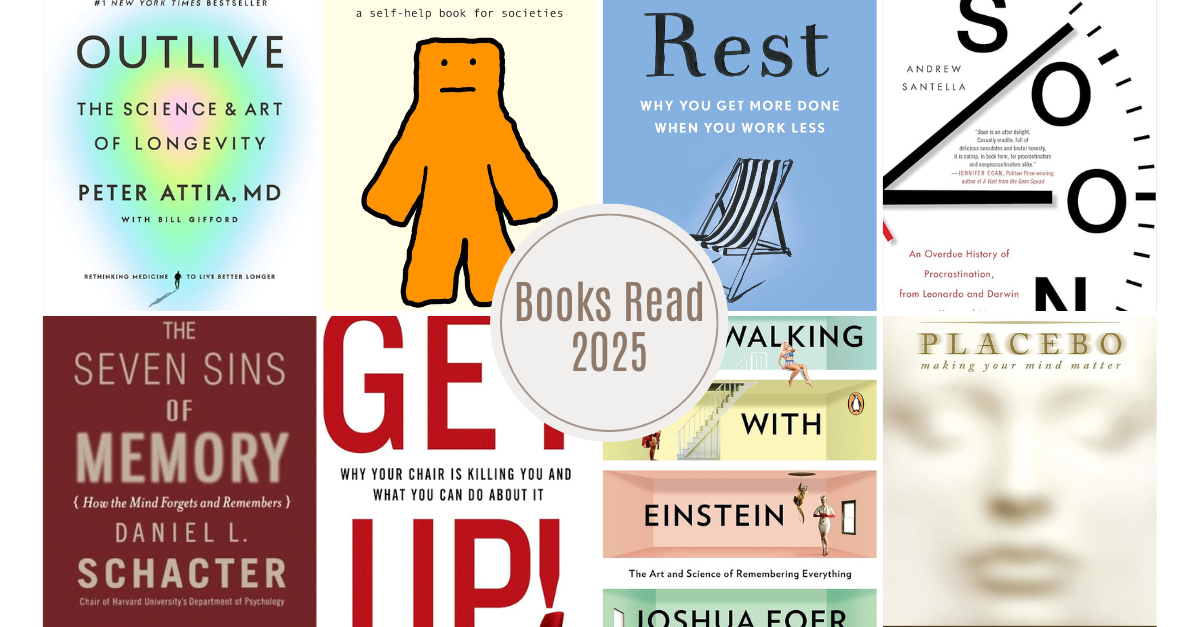
Francis Bacon once observed that some books are to be tasted, others swallowed, and some few to be chewed and digested. Looking back at my reading this year, this lens felt surprisingly natural. Here are my reflections on the books I read in 2025.
What’s Our Problem? — Tim Urban (Chewed and digested)
Every one of us belongs to multiple groups — family, siblings, work teams, professional communities, political affiliations, countries, and now, countless WhatsApp groups.
This book draws attention to the importance of understanding the health of the groups we belong to, the role we play within them, and how we might contribute to improving them. It encourages thinking beyond individual behavior and toward collective dynamics — how beliefs form, how incentives distort, and how group identities influence outcomes.
As the author aptly puts it, this is a self-help book for societies.
Moonwalking with Einstein — Joshua Foer (Swallowed)
A friendly and engaging introduction to how memory and mnemonic techniques work, framed through the author’s journey into the world of competitive memory and the World Memory Championships.
The book offers an accessible understanding of how memory can be trained and improved, making the subject approachable without becoming technical or heavy.
The Seven Sins of Memory — Daniel L. Schacter (Chewed and digested)
An exhaustive and comprehensive account of seven commonly observed weaknesses of human memory. What stands out is that these “sins” are not merely flaws — in many situations, they are also strengths, depending on context and perspective.
For anyone working with people, systems, or human-centered endeavors, understanding these characteristics of memory is essential. The book provides a strong foundation for doing so.
You Are the Placebo — Joe Dispenza (Swallowed — occasionally with a pinch of salt)
The book explores how expectation and belief can measurably influence the body, often discussed under the broader idea of the law of attraction.
What makes the book engaging is its attempt to anchor these ideas in scientific studies and data. At times, the scientific concepts feel stretched in their application, but they still offer material worth reflecting on and questioning.
Get Up! — James A. Levine (Swallowed)
A lively and story-rich book with one particularly powerful idea: NEAT (Non-Exercise Activity Thermogenesis).
The concept highlights how small, frequent movements throughout the day matter significantly. From a productivity perspective, it offers an interesting way to rethink how physical or even mental activities can be structured without prolonged sitting — helping both work output and metabolic health.
Outlive — Peter Attia (Chewed and digested)
Most people want a long and healthy life, yet responses to this desire vary widely. Some quietly hope for it, some point to exceptions and role models, and others assume it’s largely outside their control.
This book provides a clear and actionable perspective: our healthy lifespan is something we can influence, and it explains how. It also addresses a deeper question I’ve heard often — why live longer at all? — and reframes longevity in terms of quality, independence, and purpose.
Rest — Alex Soojung-Kim Pang (Swallowed)
A thoughtful exploration of how the importance of rest diminished over time and why it is gaining renewed attention today.
The book introduces multiple forms of rest and shows how rest can be consciously designed to support creativity, clarity, and sustained productivity — rather than being seen as an absence of work.
Soon — Andrew Santella (Swallowed)
A charming and reflective look at procrastination, approached with empathy and historical context.
Personally, this book challenged a quiet assumption I carried — that procrastination and laziness are closely linked. The book presents procrastination as a common human experience that can happen to anyone.
My own takeaway is that while procrastination deserves understanding, one should still remain alert to the possibility of laziness hiding under its disguise.
A note on “tasting”
If you’re wondering whether I tasted any books — yes, I did. These were books I tested and had pleasure.
- Eager: The Surprising, Secret Life of Beavers and Why They Matter — Ben Goldfarb: After using the beaver as a mascot for my program, I became curious about these remarkable animals. An enjoyable and informative read.
- Elements of Hindustani Classical Music — Jauhari Sruti: A new hobby led me to this book. A very good introduction to foundational concepts.
- Bridge For Dummies — Eddie Kantar: A new game for me, and a clear, approachable guide to getting started.
- The Management of Time — James T. McCay: A classic on time management. It was interesting to see how earlier thinkers approached the subject.
- The Home Edit: A Guide to Organizing and Realizing Your House Goals — Clea Shearer: Read out of curiosity about how physical organizing differs from digital organizing.
- Voice and the Actor — Cicely Berry: A classic work on voice and oratory skills.