
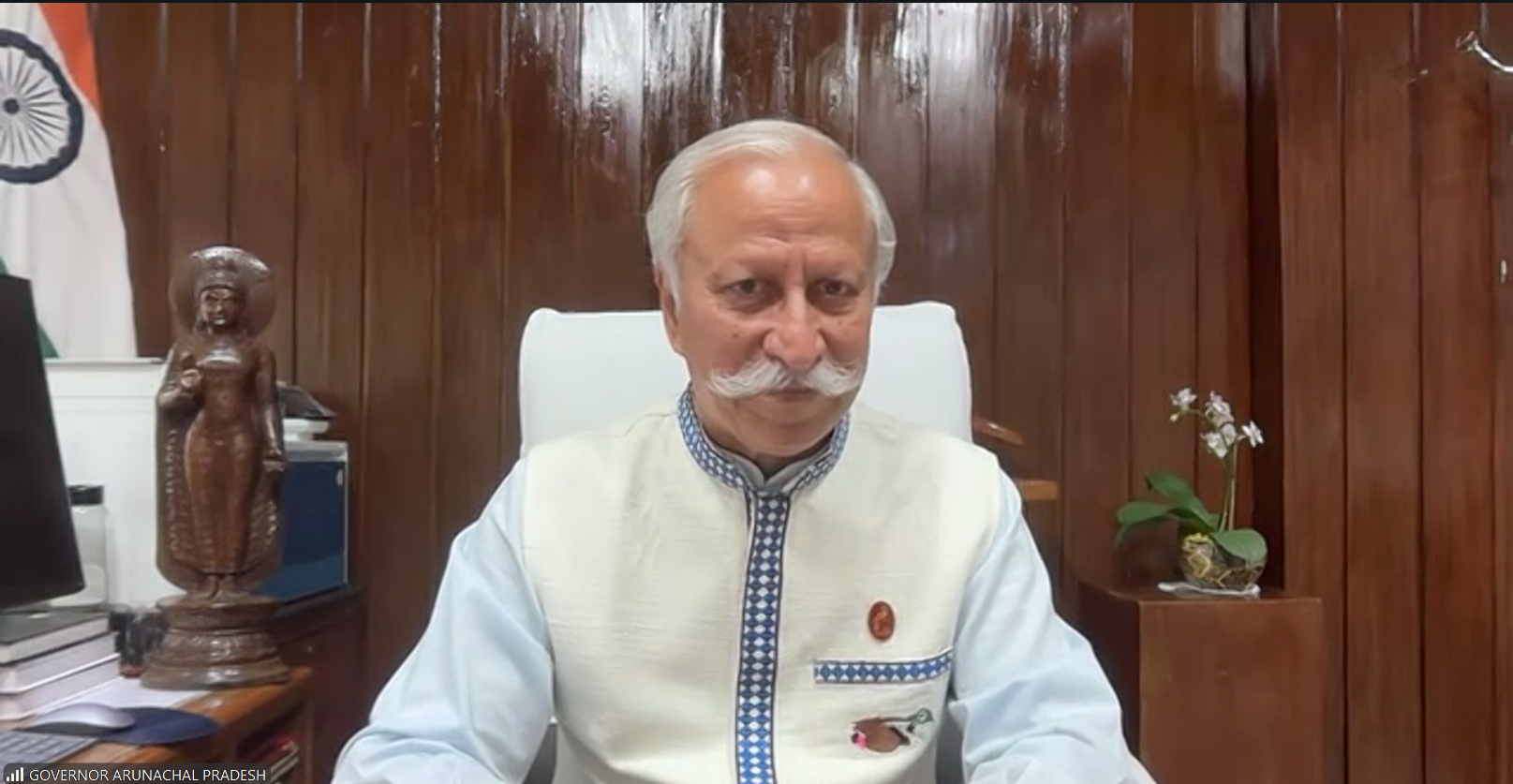
Lieutenant General Kaiwalya Trivikram Parnaik, PVSM, UYSM, YSM, currently serves as the Governor of Arunachal Pradesh. A distinguished officer of the Indian Army, he retired after a military career spanning more than four decades, culminating in his appointment as the General Officer Commanding-in-Chief of the Northern Command—one of the Army’s most strategically important commands. He also holds the distinction of being the first Maharashtrian officer to lead the Northern Command.
What struck me most during my conversation with him was that despite reaching some of the highest positions in the military and public service, he speaks less about rank and achievement and more about values, people, and responsibility.
The Making of a Soldier
General Parnaik’s story begins in a military family. His father served in the Air Force, while his mother was a teacher. Looking back, he sees much of his leadership philosophy rooted in their influence.
In fact, he comes from a third-generation military family. All three brothers eventually joined the armed forces, with military service becoming a defining thread across generations.
His father represented discipline, standards, and a passion for excellence. His mother embodied patience, care, and resilience. Together they created a home where discipline was balanced with warmth and where achievement never came at the cost of character.
At the age of nine, he left home to join Sainik School Rewa as part of one of its pioneering batches. Living away from home at such a young age taught him self-reliance early in life. Looking back, he credits the school’s teachers and principal for transforming boys from diverse backgrounds into confident, capable young leaders.
His mother’s influence extended beyond discipline and care. When he left home at the age of nine to join Sainik School Rewa, she handed him a copy of the Bhagavad Gita and asked him to keep it under his pillow. The young boy obeyed.
What began as a mother’s instruction became a lifelong practice. He has continued reading the Gita for decades and credits it with shaping his understanding of Karma Yoga. The idea of focusing on one’s duty, performing it to the best of one’s ability, and not becoming consumed by the outcome resonated deeply with him. Looking back, he sees many of his decisions and much of his leadership philosophy through that lens.
His father influenced him in a different way. An avid collector of stamps, coins, books, artifacts, gemstones, and music, he nurtured in his children a lifelong curiosity and appreciation for history. General Parnaik continues to pursue philately and numismatics even today, occasionally exhibiting his collections. His father’s advice was simple: preserve these treasures, share their stories, but never sell them.
The 1962 war left a strong impression on the nation and on a young generation that would later enter the armed forces. General Parnaik subsequently joined the National Defence Academy. The values instilled there remained with him throughout life.
One phrase from the NDA prayer in particular became a lifelong compass: to be physically strong, mentally awake, and morally straight.

For him, these are not merely military ideals but principles for life itself.
When the time came to choose a regiment, he opted for the Infantry and specifically the Rajputana Rifles, following a family tradition and inspired by an uncle who had served in the same battalion.
The Army as a Calling
The General never viewed the Army as a job. It was a vocation.
Across four decades of service, he commanded men at every level—from battalion command to some of the Army’s most significant operational formations. Yet when discussing his career, he repeatedly returns not to positions but to people.
Leadership, in his view, is not about authority. It is about trust.
He recalls numerous situations where success depended not on rank but on the willingness of people to follow a leader they respected. His philosophy was simple: remain approachable, remain humane, but never compromise professional standards.
He also strongly believes in decentralization of authority. Leaders cannot succeed by controlling every decision. Their responsibility is to create an environment where subordinates feel empowered, trusted, and accountable.
Innovation Under Pressure
Throughout the conversation, examples emerged of a leader willing to challenge conventional approaches when circumstances demanded it. One recurring idea was what he calls perception management.
The concept became one of his most enduring leadership tools. Whether dealing with operational challenges in the Army, organizational change in the corporate world after retirement, or governance as the Governor of Arunachal Pradesh, he repeatedly found that success depended not only on what was done, but also on how people understood, perceived, and responded to it.
Throughout his career, General Parnaik displayed a preference for indirect and intelligent solutions over brute force. Whether dealing with military challenges, organizational issues, or governance, he believed that understanding people, anticipating reactions, and creating leverage often produced better outcomes than relying solely on authority or force.
As he put it, one has to approach hurdles by being clever, but never mean. The objective is not to overpower people, but to find solutions that align interests, reduce resistance, and create lasting results.
This ability to understand both systems and people appears repeatedly in his military and administrative experiences.
Leadership with a Human Touch
One of the most interesting parts of the conversation involved his role as Colonel Commandant of his regiment.
Rather than focusing only on immediate operational outcomes, he invested time in building systems, creating vision statements, improving training practices, promoting sports, and strengthening morale.
He also described a welfare initiative that transformed an unused guest room into a facility where newly married officers could spend their first week together before returning to their demanding assignments.
The story reveals an important aspect of his leadership: organizational excellence and human welfare are not competing priorities. They reinforce each other.
People perform better when they feel valued.
Kashmir Premier League
One of General Parnaik’s most innovative initiatives emerged during his tenure in Kashmir.
Rather than focusing exclusively on security measures, he looked for ways to engage young people positively and create a sense of participation and pride. The result was the Kashmir Premier League (KPL), organized on lines comparable to professional cricket leagues.
Teams were formed from districts across the Valley, provided with equipment, uniforms, coaching support, and well-prepared grounds. For nearly four months, cricket became the focus of attention. Legendary cricketers such as Sunil Gavaskar, Kapil Dev, and M. S. Dhoni were invited to interact with players and inspire them.
The impact went beyond sport. For the duration of the tournament, normal patterns of unrest largely disappeared as thousands of young people became invested in the competition. The most remarkable moment came when disruptive elements attempted to derail a match. Before the police had to intervene, local spectators and community members themselves drove them away.
For General Parnaik, the episode reinforced a lesson that guided much of his leadership philosophy: lasting peace and stability cannot always be achieved through force alone. Sometimes the most effective solutions emerge when people are given something positive to participate in and something they genuinely care about protecting.
Lessons from Governance
He describes his appointment as Governor as an act of providence. After retiring from the Army, he spent several years in the corporate world and was preparing to return to Pune when the call arrived. Within days, he found himself assuming constitutional office.
Contrary to the perception that military service and governance are vastly different domains, he believes his Army background prepared him exceptionally well for the role. He often says, “I am less of a ceremonial man. I am an enabler.”
Drawing upon his experience in leadership and technology, he has actively encouraged the use of geospatial technologies and data-driven governance in Arunachal Pradesh. When speaking to students and educational institutions across the state, he frequently returns to a simple framework for nation-building: Shikshit, Anushashit, Prerit—educated, disciplined, and motivated. In his view, these three qualities form the foundation of good citizenship and future leadership.
Attention to Detail
Leadership often reveals itself in small moments.
During a visit to the cowshed at Lok Bhavan, General Parnaik struck up a conversation with the caretaker and casually asked for the names of the cows. The caretaker admitted that they had never been given names.
Rather than moving on, he paused and named them on the spot—Ganga, Jamuna, Saraswati, and Triveni. He then asked the staff to prepare and hang nameplates around their necks.
It was a small gesture, but one that reflected a recurring trait: noticing details that others overlook. More importantly, it brought a sense of excitement, ownership, and happiness among the staff. The cows were no longer anonymous animals in a shed; they had an identity, and the people caring for them felt seen and involved as well.
Another small initiative reflected the same sensibility. At Lok Bhavan, he introduced a music system that plays Indian classical music throughout the day, with ragas chosen to suit the time. Morning ragas greet morning visitors, while the music evolves with the changing hours.
A Life of Service
If there is one theme that runs through General Parnaik’s entire journey, it is leadership by example. He believes standards cannot be enforced unless leaders themselves embody them. People observe what leaders do far more carefully than what they say.
For him, leadership is neither domination nor popularity. It is service.
And perhaps that is why his career has successfully spanned soldier, commander, mentor, corporate leader, and constitutional office holder while remaining rooted in the same enduring values.
Physically strong. Mentally awake. Morally straight.
Productivity Lessons from a Lifetime of Service
When asked about productivity, General Parnaik did not offer fashionable frameworks or elaborate systems. Instead, his lessons were forged over decades of military command, corporate leadership, and public service.
- Preparation creates confidence. Whether attending a meeting, reviewing a proposal, visiting a district, or taking on a new responsibility, he believes in understanding the subject thoroughly beforehand. Preparation enables better decisions and inspires confidence in others.
- Cultivate “external calm, internal intensity.” Leaders often have to make decisions under pressure across operations, logistics, personnel, welfare, and administration. Visible panic spreads anxiety; calmness creates stability. The urgency should remain inside, not outside.
- When pressure increases, slow down. Contrary to conventional wisdom, he advises against rushing when circumstances become overwhelming. Pause, reassess priorities, and focus on what truly matters. Speed without clarity often compounds mistakes.
- Do not react immediately. One lesson from his mother stayed with him throughout life: when things go wrong, don’t start fuming or blaming. Sit quietly, understand why the situation occurred, and then respond thoughtfully.
- Clear the backlog. While commanding the Northern Army, extensive travel often left him with mountains of pending correspondence and files. Rather than letting work accumulate, he developed the discipline to clear pending decisions promptly, ensuring that others were never left waiting for his action.
- Use quiet time for reflection. Those late-night hours spent reviewing files often became periods of deep thinking. Reflection on the day’s events frequently led to fresh ideas, better solutions, and clearer priorities.
- Physical fitness is an operational requirement. Exercise, yoga, sports, and an active lifestyle have remained constants throughout his life. Good health, in his view, is not a luxury—it is a prerequisite for sustained performance and effective leadership. General Parnaik remarked that he is now in his fifty-fourth consecutive year of service, and he still fits into the dress that he wore on the first day of his service.
- Empower others through trust. Productivity is not about doing everything yourself. Leaders must decentralize authority, trust capable people, and create an environment where others can act confidently and take ownership.
- Be clever, but never mean. Obstacles are inevitable. His preferred approach is to understand people, anticipate reactions, and find intelligent solutions that align interests rather than relying solely on authority or confrontation.
- Focus on duty, not outcomes. Inspired by the Bhagavad Gita and the principle of Karma Yoga, he believes in giving one’s best effort to the task at hand without becoming consumed by the result. Consistent action matters more than worrying about success or failure.
The Karmyogi journey continues…
Each Karmyogi has a unique story, yet they all share one common trait: they have mastered time with purpose, calm, and consistency. Explore the complete collection of interviews and discover the ideas, habits, and philosophies that shaped their remarkable lives. Explore the Karmyogi Series