
“I will remember that.”
Those four words have probably created more unnecessary mental load than we realize.
We say them when we put something somewhere “for now,” when someone gives us a piece of information, when we notice that something needs to be done later, or when we tell ourselves that we will remember where we kept something. Sometimes we do. Often, we don’t. And even when we do remember, we may have to spend time searching our memory to retrieve it.
This is why I was struck by a recent post by Seth Godin, the bestselling author and one of the most widely read thinkers on marketing, work and ideas.
In his August 16 post, “Replace the filters,” Seth suggests a simple habit: when something needs replacing, put a recurring reminder in your calendar, record where the spare is kept, and save the link to buy another one. He also suggests writing down things such as the type of paint used in a room, or taking photographs of reorganized shelves and drawers so you can find things later.
His ideas are very much in line with something I have been saying about being organized. Being organized is an antidote to our fragile working memory. At its core, being organized is about retrieval.
Something that matters should be:
- Secured
- In a known place
- In a unique place
- Easy to access
When these conditions are met, you can retrieve what you need when you need it—without searching, guessing or mentally scanning.
The calendar is the simplest example. You expect meetings and events to occur, so you create a dedicated space for them. Events go into the calendar. They don’t live in your memory, scattered messages or random notes.
The same principle applies to many other things in my personal life.
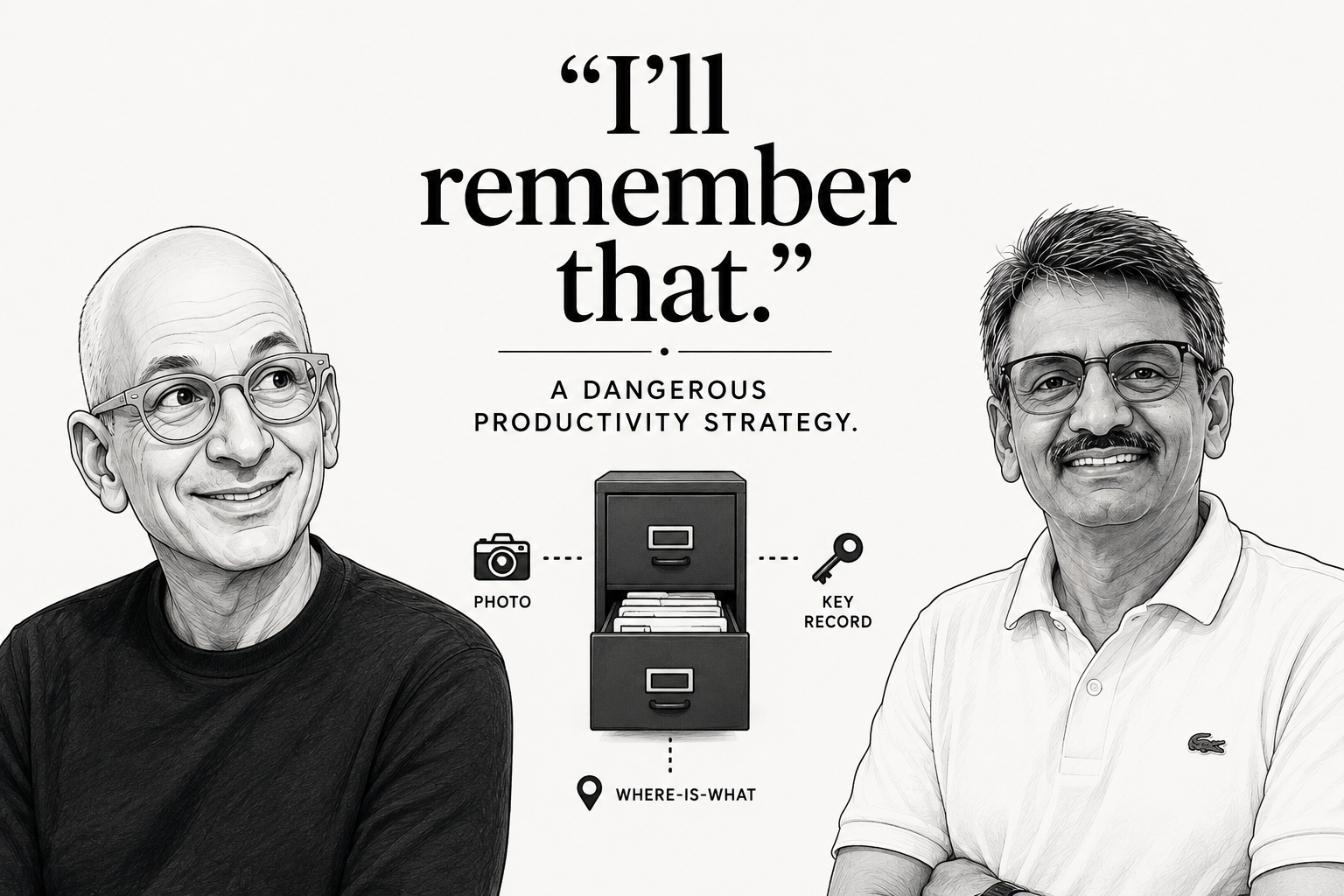
I photograph the contents of my bed-storage compartments. When I need something that is rarely used, I can look at the photograph first instead of opening several compartments to find it.
I maintain a record of important keys. It tells me what each key opens, how many copies exist, and who is holding each copy.
I maintain a “Where is what?” table for the house. It tells me where things are kept. It is particularly useful for things we use sparingly or new things that have recently entered the house—Diwali lights, a CD drive, a rarely used tool, and so on.
I keep my brand colours readily available. For each colour, I have its glyph and hex code. Whenever I create publishing material, I don’t have to remember or look up the colours—I simply retrieve them from this reference.
These are all examples of planned spaces. Sometimes the space is a calendar. Sometimes it is a photograph, a table, a folder or a checklist.
Without a planned space, things get put wherever there happens to be room at the moment—a random note, an open browser tab, an inbox or a folder you won’t remember later. The item hasn’t disappeared. But practically, it is lost because you don’t know where to retrieve it from.
Being organized, therefore is about deciding in advance where things belong and maintaining those spaces so retrieval remains effortless. There is some upfront effort in creating these spaces. But that effort is largely one-time, while the benefits compound: less searching, less resistance to starting, fewer last-minute surprises and greater clarity about what deserves your attention.
So the next time you catch yourself or others around you thinking:
“I’ll remember that.”
Stop.
Don’t remember it. Design a place for it.
With thanks to Seth Godin’s August 16, 2026 post, “Replace the filters,” for the reminder.