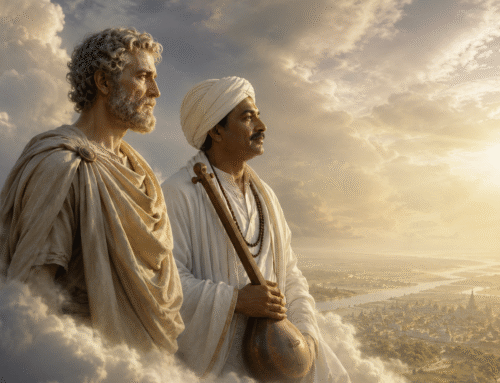


American statesman and Founding Father Benjamin Franklin famously observed:
“In this world nothing can be said to be certain, except death and taxes.”
Our modern world is, in many ways, safer than that of earlier generations. We have better medical care, fewer deaths from many infectious diseases, lower child mortality, and, at least in many parts of the world, less exposure to war and violence. Having grown accustomed to longer, healthier lives, perhaps we find it harder to contemplate their end. We have more to lose—or, at least, more life that we hope to experience.
The human brain is an extraordinary instrument. It allows us to imagine possibilities, contemplate abstract ideas, and think far into the future. The civilisation we have built is, in large measure, a product of this remarkable ability. Yet the same faculty can become a burden when we overthink things we cannot control, death being one of them.
Perhaps a zoomed-out view of who we are can help put these fears in perspective. Life on Earth began billions of years ago in simple forms, and evolution has since seen countless species emerge, flourish, and disappear. We humans, too, are just one chapter in this vast, ongoing story. Each of us is a tiny participant in a process that began long before us and will continue long after us. This perspective can simply remind us that we are part of something much larger, and that we need not carry the entire weight of existence on our shoulders.
Death is certain, yet accepting that certainty is not necessarily easy. As we grow older, one of our fears is the prospect of losing our health and spending our final years dependent on others or confined to bed. Perhaps, therefore, our goal should not be merely to extend our lifespan, but to extend our healthspan—the years we live in reasonably good health, with the ability to remain active and independent.
Those additional decades should be years to live, not merely years to survive. A balanced diet, regular physical exercise, adequate sleep, and consistent attention to our health can all help us work towards that goal. We cannot guarantee how long we will live or how healthy we will remain, but we can take reasonable responsibility for the quality of the life we have.
One reason death frightens us is that it seems to rob us of an endless list of future possibilities: places we wanted to visit, books we wanted to read, experiences we wanted to have, and years we hoped to enjoy. But consider this: after death, there is no one there to experience that sense of missing out. The person who has died does not spend eternity regretting the journeys not taken or the pleasures not experienced. The loss of those possibilities is something we contemplate while we are alive; it is not an experience the dead must endure.
This does not mean that we should dismiss grief or tell ourselves that death is inconsequential. The people who remain experience a very real loss. We cannot eliminate their grief, but we can do everything we reasonably can during our lives to reduce the practical and emotional burdens our absence may leave behind. We can put our affairs in order, make important information accessible, and ensure that the people who depend on us are not left struggling unnecessarily.
Sleep gives us a glimpse of what death might be like: a state in which we are unaware of the world and the passage of time. We close our eyes, lose awareness of the world, and hours may pass without our experiencing their passage. We do not usually struggle against sleep; we surrender to it naturally and wake up to continue living. Of course, sleep is temporary and death is permanent. The analogy has its limits, but it reminds us that a period without conscious experience is not necessarily something we need to fear as an experience in itself.
We are sometimes concerned about the deaths of our near and dear ones. The Stoic philosopher Epictetus offers a perspective worth considering. He advises us to remember the impermanence of things, including the people we love. We should see them as fellow mortals, recognising that they may not always be with us.
Recently, my cousin lost his 23-year-old son, a doctor who was doing his internship. Who could have imagined that such a promising young life would end so soon?
It is difficult to contemplate a loss like this. But what the Stoics want to convey is not that we should become detached from those we love. It is quite the opposite. Knowing that our time together is limited should make us cherish it more. Talk often. Meet whenever you can. Enjoy one another’s company. Forgive the little slips and mistakes that are inevitable in any relationship. Do not let minor disagreements, wounded pride, or the endless demands of daily life consume time that could have been spent together. We cannot control how long our loved ones will be with us, but we can make better use of the time we have.
There is a fundamental difference between knowing intellectually that life will end and being alive. Evolution has wired us to survive, protect ourselves, seek pleasure, form attachments, be curious, explore, achieve, and experience. These impulses are not things we can simply switch off because we understand that death is inevitable. Our minds may contemplate mortality, but our living bodies and brains continue to engage with the world.
And perhaps that is the point. Accepting death does not mean withdrawing from life. We continue to love, work, sing, explore, enjoy, worry, hope, and look after the people who matter to us. We can accept that our time is limited without spending that time in constant fear of its end.
I think no one puts it better than Epictetus:
“I must die, must I? If at once, then I am dying; if soon, I will dine now, as it is time for dinner, and afterwards, when the time comes, I will die.”
There is something wonderfully matter-of-fact about this response. If it is time for dinner, have dinner. When the time comes to die, we will die. In the meantime, there is a life to be lived, health to be cared for, people to be loved, and a world to be experienced.