

I may not have been much of a sportsman, but I have always been someone who exercised.
I could, at best, be described as a nerd. I never played sports with any particular regularity or success. I don’t know which was the cause and which was the effect! But that never came in the way of my exercising regularly.
During my school days, it was the humble Surya Namaskar and squats, done at home. In undergraduate college, we had what passed for a gymnasium: a few essential pieces of equipment, a bunch of mirrors and, right in front of the hostel, a set of parallel bars (such installations were fairly common in those days, but are sadly missing nowadays). Dynamic, swinging pull-ups on those bars became my routine. They were quite an awe-inspiring sight for passers-by! Those workouts certainly helped me work up an appetite—and make peace with whatever the hostel mess happened to serve!
At my first job, I joined a karate class. It was run by a tall gentleman from North India who looked quite different from the local population of the small town where I was working as a lecturer at a newly established engineering college.
I am not sure whether postgraduate studies drew me more towards IIT Bombay or its swimming pool! Whatever the reason, after securing a good GATE score, I joined IIT Bombay and lost no time getting into the pool. Those one-and-a-half years were filled with daily swimming, occasional gym sessions and evening jogs along the maintenance road running beside the Powai water pipelines, often bathed in the golden evening sunlight.
After leaving college, I settled into a pattern of swimming during the summer and going to the gym during the rest of the year. This continued for many years.
At different stages, I thought I should stop going to the gym for various reasons and switch to a “maintenance” routine, perhaps through yoga. Eventually, I realised that a gym isn’t just for the young. In fact, maintaining muscle strength becomes even more important as we grow older.
My latest return to regular strength training came on 15 July this year. I decided to set up a modest home gym, with just a small collection of dumbbells and resistance bands. Nothing elaborate. Just enough to get going.
So, where is the productivity angle?
Well, if you are still looking for the thread about being organised, personal productivity or time management, it’s coming!
If you have been following my newsletter, you must have heard me talk about the importance of journaling for productivity several times.
I am not referring to the conventional Dear Diary kind of journal, where we pour out our thoughts and feelings at the end of the day. I am talking about a productivity journal.
The idea is simple. Maintain a concise record of what you accomplished each day across different performance areas of your life — work, household responsibilities, health, hobbies, and so on.
These are not elaborate accounts of the day. Just a few crisp notes, recorded consistently and without missing a day. Each area has its own dedicated space, so the entries remain organised and easy to retrieve. It takes hardly five minutes, spread across the day, to maintain this record.
I also maintain a simple running counter for repetitive activities. For instance, an entry might read #Swimming 2026 #21 (700m), #Tekdi #22 or #Strength #64. These little counters tell me how many times I have engaged in a particular activity. Even without elaborate reports or visualisations, they provide a simple indication of how consistently I have been pursuing an activity and how a habit is gradually taking shape. There is something satisfying about seeing those numbers climb!
There is something I particularly like about this practice. It is, in a way, a pat on your own back. The idea is to record the things you feel good about having accomplished. Not necessarily spectacular achievements, but the little things that matter to you. You exercised, made progress on a project, learnt something new, attended to a household responsibility, read a few pages of a book, or spent time pursuing a hobby. A few words are enough.
Recording these accomplishments is a way of acknowledging your own efforts. When you do this consistently, you reinforce the behaviours you want to continue. Over time, the practice itself helps turn these activities into enduring habits.
There is also a bigger picture to discover. When you look at the record of a particular day, you get a sense of how productive you were and how varied your activities were. Did you make progress on different fronts? Did you use your available energy for the tasks that were appropriate to it? A good day need not be one spent entirely at work. It can be one in which you made meaningful use of your time and energy across several dimensions of life.
And when you look at any one of these areas over a longer period, you begin to see something even more valuable: consistency. You can see whether you have been showing up regularly and appreciate how small, repeated efforts can compound into something substantial.
There is another very practical benefit. These daily records make preparing weekly and monthly reviews almost effortless. Instead of trying to recall what you did over the past week or month, you simply go through your journal. You have the evidence right there!
You can review what you accomplished, what received less attention than it deserved, and whether you made progress on the fronts that matter to you. The weekly review helps you stay on course, while the monthly review gives you a somewhat broader perspective.
And these records have a value beyond routine reviews. They can be revisited and analysed much later, sometimes in ways you hadn’t imagined when you first made those entries. This is one reason I place so much importance on maintaining a productivity journal.
An interesting experiment with my journal
I have created some wonderful reports from my journal for different audiences, including myself! I will share some of those experiences in due course. But today, let me talk about one particular experiment related to my physical workouts.
As I mentioned earlier, I returned to strength training in mid-July this year after a brief hiatus, this time with a stronger conviction that strength training is something one should never really give up. The intensity, of course, can always be adjusted to suit one’s capacity. I was curious to see how I had been doing, so I decided to take a closer look at my exercise record.
What makes this experiment even more interesting is how modern-day AI has made creating visually appealing reports almost child’s play. You no longer need to be a data analyst or spend hours preparing charts and visualisations in a spreadsheet. I hope this opens up yet another reason to take journaling seriously!
I picked a period of a little over three months, from 15 July to 31 October 2026, and gave ChatGPT a raw dump of my daily journal entries.
I asked it to identify and classify six different kinds of physical activity:
– Strength training: Entries explicitly marked #Strength.
– Stretching: Entries explicitly marked #Stretch.
– Brisk walking: Days on which I recorded 5,000 or more #steps. I deliberately excluded days with 3,000 or 4,000 steps.
– Swimming: Entries explicitly mentioning #swimming.
– Hill: Entries mentioning #Tekdi climbing.
– Table Tennis: Entries indicating that I had played #TT.
I then asked ChatGPT to create a calendar showing these activities day by day, using a different colour for each.
The colour scheme was simple: dark pink for strength training, light pink for stretching, grey for brisk walking, blue for swimming, bright green for Tekdi and purple for table tennis. A day with multiple activities would have multiple horizontal colour bands. And there it was!
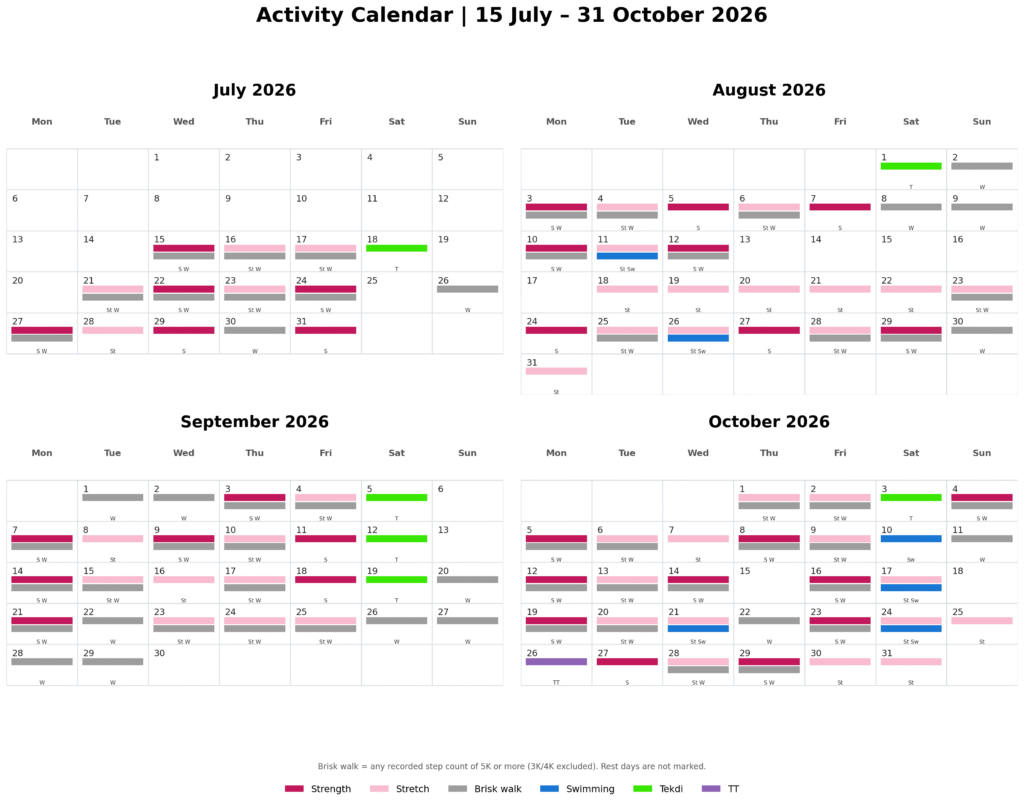
What had been scattered across months of chronological journal entries was now presented in a single visual calendar. I could see the different activities together, day by day, without having to browse through individual entries.
I hadn’t maintained an exercise database. I had simply maintained a journal.
Think about it. When you record something today, you may not have a particular reason to analyse it later. You are simply maintaining a record of what you did. They become a historical record that you can revisit, examine and learn from.
You could look at how regularly you pursued a hobby, how much attention you gave to your health, how your reading habits evolved or how consistently you worked towards a particular goal. You may discover patterns that you hadn’t noticed while living through those days.
And perhaps the most satisfying benefit of all:
When I see such a proud record of my efforts, I would think twice before giving up any of these routines!
My exercise-calendar experiment is just one example of what is possible. I could have spent hours going through months of journal entries, counting activities and preparing a calendar manually. Instead, I got ChatGPT to do the extraction and create a visual representation of the information. What I found particularly interesting was how easily I could go back and forth, refine the presentation and arrive at something that was both useful and visually appealing.
This is perhaps one of the most exciting possibilities that AI brings to journaling. It makes the information we have painstakingly accumulated over time much more accessible and easier to analyse. And I hope that the prospect of turning everyday notes into such interesting reports will encourage more people to take up journaling.
Of course, none of this is possible without the underlying habit. AI cannot extract meaningful insights from records that were never maintained in the first place.
So, if you haven’t already developed the habit, perhaps it’s time to start journaling. Don’t worry about writing elaborate accounts of your day. A few sharp notes, recorded consistently and organised well, can go a long way. Don’t forget, without a strong reminder, even the best intentions can fade away. Set a daily reminder and make journaling a part of your routine. Before long, it should become second nature.
Record your accomplishments today. Appreciate your consistency tomorrow. Discover the value of both when you look back over time.
Subscribe to my newsletter, to get tips like this and more, directly in your inbox!