

Imagine waking up on a rainy Sunday and wondering, “What exactly did I do with the last six months of my life?”
Most of us can answer only in broad strokes: worked a lot, attended meetings, read a few books, spent time with family. The details have already evaporated.
Now imagine opening a neat matrix and being able to see, day by day, what you built, learned, fixed, wrote, read, and experienced. Not because you have an extraordinary memory, but because you kept a simple journal.
Before you stop reading, this is not the “Dear Diary” kind of journal.
This journal is more like a flight recorder for your life.
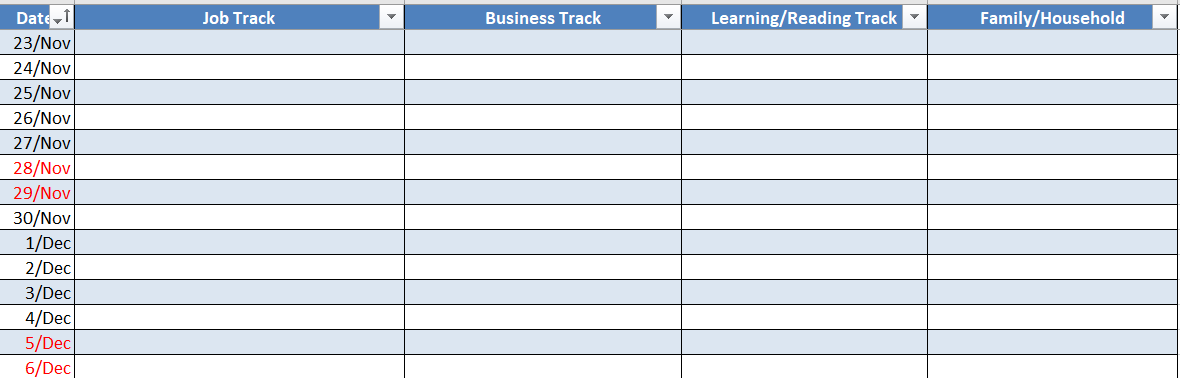
Every day gets one row. Every important role you play gets a column. Mine typically has four columns:
- Job
- Vocation
- Reading & Learning
- Personal & Family
Whenever you finish something meaningful, record it in the appropriate cell. A client presentation. A chapter of a book. A long walk with your spouse. A difficult conversation. A blog post. A new skill.
Over time, the spreadsheet becomes surprisingly fascinating.
One glance tells you whether your days are balanced or lopsided. Are you investing in learning? Have you neglected family for three weeks? Is your side project moving forward or merely living in your imagination?
The journal also becomes an unexpected source of satisfaction. There is something deeply rewarding about looking at a row packed with meaningful activity. It is tangible evidence that your days were not wasted.
And the benefits keep accumulating:
Reflection and Completion
Recording a task forces you to revisit it briefly. Did you leave any loose ends? Did you finish it properly? This tiny moment of reflection often improves the quality of your work.
Your Personal Highlight Reel
Most people underestimate how much they accomplish. A journal serves as a visual reminder of your progress. On difficult days, it can be surprisingly motivating.
A Built-in Time Machine
Need to remember when you submitted that proposal, completed that course, or started that project? The answer is usually a quick search away.
Effortless Reporting
Weekly reports become simple. Monthly reviews almost write themselves. Annual self-appraisals, resumes, and career profiles become far easier because the raw material is already available.
Balanced Attention
Reading down a single column reveals patterns. If your Learning column is empty for weeks, or your Personal column looks neglected, the journal gently points it out.
Productivity Without a Stopwatch
You do not need elaborate time-tracking systems. Simply recording meaningful accomplishments often provides enough visibility into how productive your days have been.
A few practical tips:
- Keep it digital.
- Use a spreadsheet.
- Record items as soon as possible after completion.
- Finish updating the day before you shut down for the evening.
- Highlight weekends in a different color to create visual boundaries between work weeks.
- Enable the Microsoft Office Clipboard if you frequently copy information from emails and documents.
The hardest part is not creating the journal. It is showing up every day.
But once you have a few months of entries behind you, you’ll wonder how you managed without it.
If you’re looking for a New Year’s resolution that takes just a few minutes a day and keeps paying dividends for years, consider becoming the historian of your own life.