


Do you write down “Have breakfast” on your To-Do List? What about lunch, dinner, or your evening cup of tea? Probably not. These are part of your daily routine. You don’t need reminders for things you do automatically. But what about the other things you need to do? Should all of them go on your To-Do List? Let’s find out.
I’d like to look at our tasks from this perspective and divide them into three categories.
1. Things that are already part of your routine
You brush your teeth, have your meals, and perhaps go for your evening walk. You don’t need to record these activities if you do them automatically.
But suppose you’ve recently decided to exercise every morning or practise singing every evening. Until these activities become habitual, a reminder might help.
2. Things that must happen at a particular time
A dentist’s appointment, a meeting with a colleague, or a deadline for submitting a report needs your attention at a specific time or by a particular date.
Your calendar is the right place for such commitments. You can also set reminders for recurring activities, such as watering your plants every Sunday.
3. Things you can do at any time
You need to buy a book, reply to an email, research a holiday destination, fix a computer problem, or prepare an article for publication.
These are tasks you intend to do but can complete whenever you have the time and opportunity. They belong on your To-Do List.
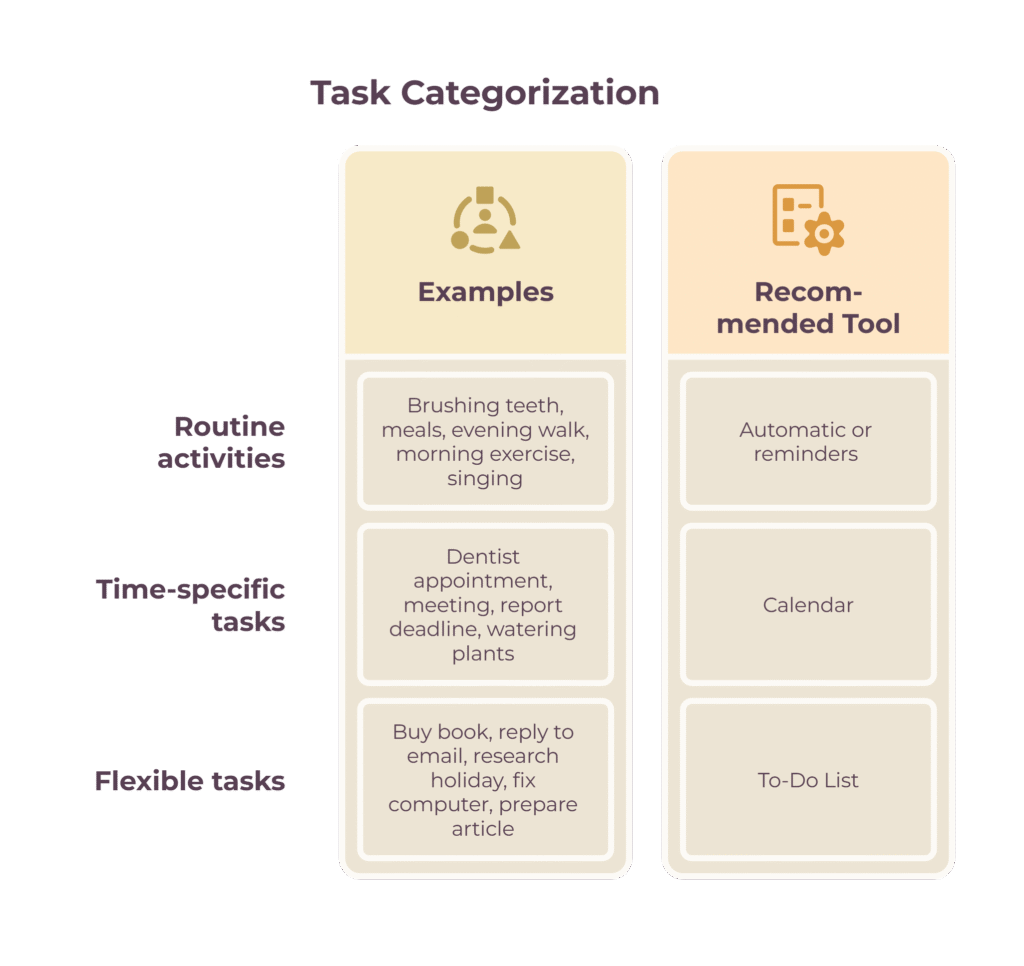
The principle is simple: don’t record routine activities unnecessarily, put time-specific commitments on your calendar, and capture the remaining tasks on your To-Do List.
“Wait! Wait! You’re going too far! First, I’m not even sure I need a To-Do List!”
Ah! I hear you.
Perhaps you’ve tried maintaining one and found it cumbersome. Maybe your list grew so long that you stopped looking at it. In fact, I’ve written about the common problems people face with To-Do Lists and how to overcome them.
But let’s not confuse the difficulties of maintaining a To-Do List with the need to keep track of our commitments. You may use a notebook, an app, or another system. What matters is having a reliable place to record the things you intend to do.
Every day, newer tasks and responsibilities compete for our attention. Someone asks us to do something, we notice a problem that needs fixing, or we think of an idea worth pursuing. Meanwhile, earlier commitments gradually recede into the background—not because they are unimportant, but because something newer has occupied our attention.
Our biggest problem is often not the work itself but remembering all the tasks that we are committed to.
Think about the tasks that get done because someone keeps reminding you. A colleague follows up, a client asks for an update, or a family member nudges you. The task stays on your radar, and eventually you act on it. But what about the tasks nobody chases you about? You may want to learn a new skill, exercise regularly, write a book, or pursue a personal project. These may be extremely important to you, yet nobody is going to keep reminding you.
Sometimes, people trust you to deliver and don’t follow up. Sometimes, they forget. And sometimes, the task matters only to you. These are precisely the tasks that risk slipping through the cracks.
A To-Do List is non-negotiable if you want to keep track of your commitments. It acts as an external memory, protecting your intentions from being crowded out by newer demands.
Of course, adding a task to your list doesn’t get it done automatically. You still have to roll up your sleeves and do the work. That’s why you need another habit: before deciding what to work on next, consult your To-Do List. It helps you choose from all your outstanding commitments rather than acting only on whatever happens to be on your mind.
A list won’t do the work for you. But it will help ensure that the work you intend to do doesn’t get forgotten.