
As a productivity coach for knowledge workers, I spend a lot of time talking about being organized at work. And when I say “organized,” I usually mean organizing our digital world.
- A task.
- A document.
- A bookmark.
- A checklist.
- An email.
- A note.
Most of what we work with today exists somewhere on a screen.
Very recently, one of my clients asked me a question:
“You have given us some wonderful ideas on how to organize our digital world. Do you also have any tips on organizing the physical world?”
I said, “No. Not because I think physical organization is unimportant. I simply don’t venture into that area. There are professional organizers who specialize in organizing homes and physical spaces, and they certainly know much more about it than I do.”
I also assured him that the underlying philosophy isn’t very different, and suggested he check out my blog post on the topic
I had actually thought about this quite some time ago. I had always wondered how similar the two would be in practice. And at some point, I picked up The Home Edit by Clea Shearer and Joanna Teplin.
As I went through it, I found something both pleasing and, at the same time, not particularly shocking.
Professional organizers think about organization in much the same way I do.
In fact, when you think about it, it would make sense that physical organization came first. Many of the principles we now apply to digital information are probably descendants of principles developed for organizing physical things.
Here are some of the similarities I noticed.
1. Organization is about making things functional
The objective isn’t simply to make a space look tidy. It is to create a space that is clutter-free and functional.
The same is true of a digital system.
A beautifully arranged folder structure that makes it difficult to find anything isn’t an organized system. Organization should make things easier to use. We should have a unique, planned place for everything we deal with in our work.
2. Organization saves time
This one is obvious once you experience it. If you know exactly where something is, you don’t have to search for it. And if you have a designated place for something, putting it away becomes almost automatic.
The same principle applies to digital information. Put things in their right places at the first opportunity, and they become much easier to find when you need them.
3. Good organization takes some work
Organizing isn’t easy. It takes time. But once you have a good system in place, maintaining it becomes much easier, although not easy. That’s true whether you’re organizing a kitchen drawer or your digital files. The initial investment can save you a lot of effort later.
Once you experience the tangible and intangible benefits of being organized, you become more willing to pay the small price of maintaining the system. You save time not because you work faster, but because you spend less time looking for things.
4. Organization gives you a sense of calm
Clutter creates a certain amount of background noise. When things are lying around without a place, your brain keeps getting little reminders that something needs attention. When clutter is minimized and systems are in place, things feel different. You feel more grounded.
You know where things are. You know what needs to be done. And perhaps most importantly, you don’t have to keep everything in your head. That is true of both physical and digital organization.
Physical organization is part of work management too
There is one more way I look at this. If you have a system for managing your work, organizing things is actually a subset of the overall system. Work management doesn’t begin with organization. Before you organize something, there is usually a preprocessing phase.
Something comes into your world.
You receive an email.
You have a conversation.
You read something.
Someone gives you a document.
You come up with an idea.
You first need to process that stuff and, where necessary, turn it into tasks, reference material, checklists or other artifacts. Then comes organization. And after organization comes the other side of the system:
When and how will you access it?
You organize a document so that you can find and use it later. You organize a task so that you can see it when you are ready to work on it. You organize reference material so that it is available when you need it. So organization isn’t the end goal. It is the bridge between processing something and using it effectively.
There is one thing physical organization has that digital organization doesn’t quite have
And that is aesthetics. A physical space has to work, but most of us also want it to look good. A well-organized kitchen, bookshelf or desk can give you pleasure simply because it looks inviting. Digital organization has aesthetics too, of course.
We care about how our desktop looks. We choose attractive apps. We arrange things neatly. But the definition of beauty is somewhat different. But aesthetics play a much smaller role in digital organization. The stakes simply aren’t as high.
And what about the physical things in our work?
Even in a predominantly digital work-management system, we still have physical things:
- Books.
- Notebooks.
- Pens.
- Paper documents.
- Equipment.
- Cables.
Things we need to keep for a project. The simplest principle I can think of for organizing these is: Don’t rely on your memory.
Give things a planned place. When you get the opportunity, put things back in that place. And if a physical space is difficult to access or contains many things, make a note of what is where. You could even take a photograph. A photograph of the contents of a storage box may save you from opening the box six months later just to remember what you put inside it.
If you’d like to go deeper into the idea of planned spaces, you can read my detailed post, You Don’t Need More Storage. You Need Planned Spaces.
Don’t make your brain remember where things are. Make the system remember for you.
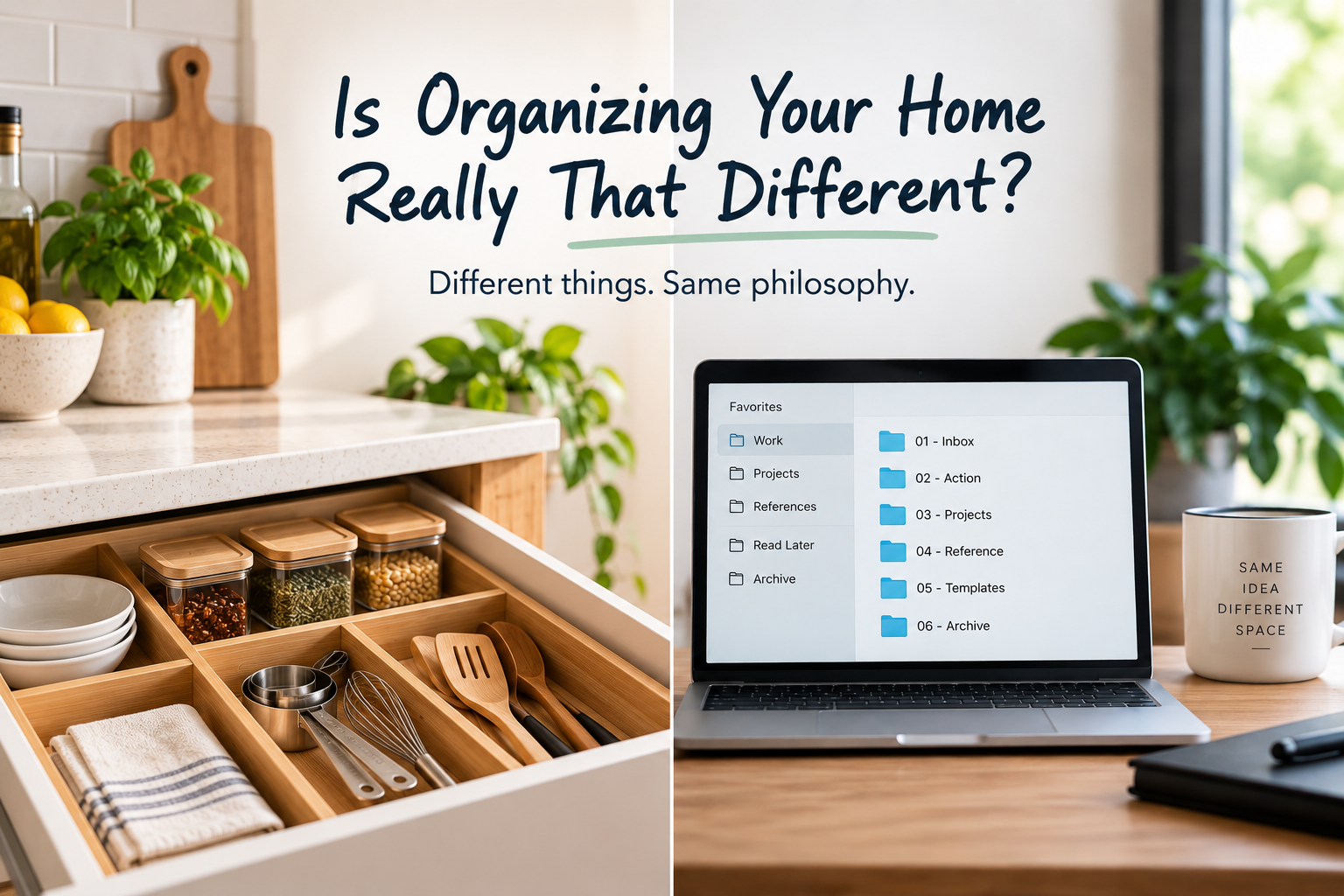
Whether the “system” is a folder on your computer, a task manager, a bookshelf, a kitchen drawer or a storage box, the underlying philosophy remains remarkably similar.
Different things. Different tools. Different spaces.
But much the same idea:
Give everything a place, and make that place work for you.
Subscribe to my newsletter, to get tips like this and more, directly in your inbox!