


We all make commitments throughout the day. A colleague asks us to look into something. A customer reports an issue. An email requires a response. Someone at home asks us to pick up something on the way back or place an order for a household item.
We usually have every intention of doing what we have promised. Yet, some of these commitments simply slip through the cracks.
It isn’t necessarily because we are careless. Our days are full of competing demands. We move from one task to another, an urgent matter takes precedence, and before we know it, something we had promised to do has disappeared from our radar.
The obvious thing to do, then, is to get commitments out of our heads and record them somewhere we can refer to later. But before we get into how to do that, let’s look at some common ways in which we can go wrong when dealing with commitments.
Let’s look at some common capture traps.
1. “I’ll remember this!”
This is probably the most common trap. We make a mental note of something, confident that we will remember it when the time comes.
More than a decade ago, when I was leading a team of software developers, I frequently interacted with colleagues from our Business Development and Software Support teams. They brought us client requirements, reported issues and followed up on pending matters.
Ralph, one of my colleagues, would often call me on the intercom to check on progress or share some observation from a client.
Imagine this: I was in a meeting with my direct reports, discussing a project or resolving some issue. The intercom rang. The caller ID showed Ralph. I picked up the call, listened to him and promised to investigate the matter or provide him with an update. I then hung up and returned to the meeting.
The meeting continued, with discussions moving from one topic to another. Once it ended, I got caught up in the next task, another meeting or an urgent request. Ralph’s request gradually slipped out of my mind. Quite often, I would remember it only when Ralph called the next morning asking for an update!
I had every intention of following through. But I had made only a mental note of the commitment, and that wasn’t enough.
Eventually, I developed a habit of keeping my notebook handy. Whenever I expected a conversation that might result in a commitment, I would open it beforehand. Whether it was Ralph or any of my other colleagues calling with a request or an update, I made sure I was ready to jot things down.
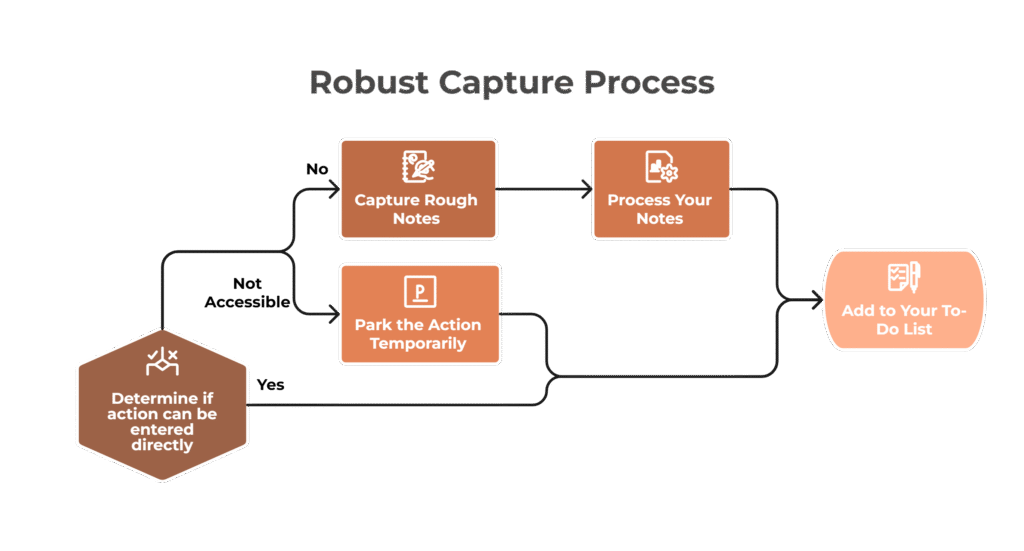
The remedy: Don’t rely on your memory, even for small or apparently insignificant commitments. If your task list is accessible, enter the action directly. Otherwise, make a quick note in your notebook or on your phone.
But here’s an important distinction: making a note is only an intermediate step. If you capture something in an intermediate place, such as your notebook or phone, make sure you process it later and transfer the resulting actions to your master to-do list.
2. “I’ll process these notes later.”
While capturing commitments during phone calls took me some time to learn, taking notes during meetings was already an established habit. I rarely attended a meeting without my notebook.
Thomas, a colleague from one of those departments, noticed this habit. Several months later, he remarked, in a tone that was both appreciative and sarcastic, that he admired how diligently I noted every detail during meetings. He only wished I would implement them with the same diligence!
He had a point.
Taking notes is not the same as ensuring that the resulting actions get done. I did occasionally revisit my notes and act on them, but often by chance— someone reminded me about it.
The problem was that I had no dependable process for reviewing my notes, identifying the actions and transferring them to my task list.
The remedy: If you capture information in a notebook, on your phone or through voice notes, make sure you process it. Go through the raw notes, identify the actionable items and enter them into your master to-do list.
And don’t make another mental note to process those notes later! Put an explicit task in your list, such as “Process today’s meeting notes” or “Review phone call notes and identify pending actions.”
Otherwise, your notebook could become a graveyard of good intentions!
3. “I’ve read the email. I’ll get back to it.”
Here’s a trap that has become increasingly common with our dependence on smartphones.
You are travelling or waiting somewhere and decide to check your emails. You come across one that needs some attention. Perhaps you need to examine an attachment, consult someone or provide a considered response. You read it, but cannot do anything about it at that moment.
When you next sit down to process your emails, you scan your inbox for unread messages. That particular email is no longer among them. It has already been read, and you may never come across it again until the sender follows up.
The trouble is that we often use the unread status of an email as a reminder that something needs attention. Once we read it, we inadvertently remove that reminder.
The remedy: Don’t use the unread status as your task-management system. When you sit down to process your emails, review all messages received since your last proper review, including those you may already have opened on your phone. Don’t restrict yourself to unread messages.
Identify the actions that need your attention and capture them in your task list. You may also flag or otherwise mark the email for follow-up, but don’t let that be your only reminder.
Remember, reading a message is not the same as processing it. And processing it doesn’t necessarily mean completing the action.
4. “We discussed it. That’s enough.”
Not all commitments arise in formal meetings or written communication.
A colleague catches you in the corridor and asks you to look into something. Your spouse reminds you to pick up a household item. Your child asks you to help with something over the weekend.
These conversations are casual, and neither party thinks of creating a record. The person making the request assumes you will remember. You, of course, assume the same!
A few days later, the request resurfaces, sometimes accompanied by a disappointed “I had asked you about this, remember?”
The remedy: Whenever possible, encourage the other person to send a quick email or message. It needn’t be a formal communication; even a short message gives you something tangible to refer back to.
If that isn’t practical, make a quick note yourself. A phone note is often all it takes.
The important thing is that a commitment should not remain buried in a conversation that neither person can reliably refer back to.
Capture first. Don’t leave it to memory!
The common thread running through all these situations is simple: we cannot depend on our memory to keep track of everything we have promised to do.
Capture doesn’t mean recording every detail of every conversation. It means ensuring that actionable commitments eventually make their way into a trusted task-management system—your master to-do list.
Sometimes the action is clear and you can enter it directly. At other times, you may need to capture rough notes first and process them later. Either way, make sure nothing gets lost in between.
Capture is only the beginning. The next steps are to process what you have collected, organise the resulting actions and review your list regularly. But none of that can happen if the commitment was never captured in the first place.
Don’t just trust yourself to remember. Capture it!
Subscribe to my newsletter, to get tips like this and more, directly in your inbox!